
Cabin, hold or manifest cargo: on a commercial flight there is one answer
Last verified: 2026-08-25
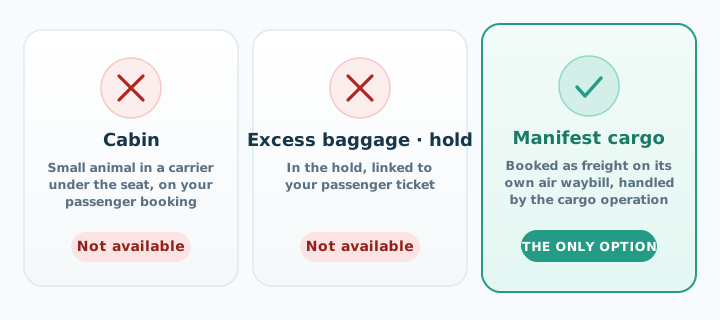
The answer
On a commercial flight: no. Your cat or dog cannot travel to Australia in the cabin with you, and cannot travel as excess baggage. The department is direct about it — “Your cat or dog must travel to Australia as manifest cargo” — and its stated reason is traceability: manifest cargo keeps the animal identifiable and accounted for throughout the journey.
This is a government import condition, not an airline preference. No carrier can waive it, and no fare class changes it.
On a private or chartered flight: there is an exception, and it is the department’s own.
Your cat or dog can travel to Australia in the cabin of a private or chartered flight. They do not usually travel as manifested cargo.
That is a real pathway, not a loophole, and it comes with its own conditions — a notice of intent before departure, written approval, a Victorian first-point-of-entry airport and approved handling on arrival. It is covered in full on private and chartered flights.
For almost everyone reading this, the commercial answer is the one that applies. But “pets can never fly in the cabin to Australia” is too strong a statement, and this page used to make it.
What “manifest cargo” actually means for you
The three ways an animal can fly are genuinely different products, and only the third is available here:
| What it is | Available for Australia | |
|---|---|---|
| Cabin | Small animal in a carrier under the seat, on your passenger booking | No on a commercial flight; yes on a private or chartered one |
| Excess baggage / hold | In the hold, linked to your passenger ticket | No |
| Manifest cargo | Booked as freight on its own air waybill, handled by the cargo operation | Yes — the only commercial option |
Practical consequences worth planning around:
- The booking is a freight booking, made through an airline’s cargo division or a pet transport agent — not through the passenger reservation system, and not by adding a pet to your own ticket.
- Your animal has its own air waybill number. Terminal service fees are charged per air waybill.
- You do not need to be on the same flight. Manifest cargo travels independently, which is why unaccompanied pet relocation is possible at all — and why matching your flight is a preference rather than a requirement.
- Drop-off and collection happen at cargo terminals, not passenger check-in.
If you have moved a pet within Europe or North America in the cabin, none of that experience transfers. This is a different transaction with different counterparties.
And it can only land in one place
Cats and dogs must arrive directly into Melbourne International Airport, where the department transfers them to the post-entry quarantine facility. They cannot land at another Australian airport and continue to Melbourne on a domestic flight.
So if you are moving to Perth, Brisbane or Sydney, your pet’s journey still ends at Melbourne first. Route planning starts from that fixed point, not from your own destination. See approved airports and routes.
What this page does not tell you
- What manifest cargo costs. It is quoted per shipment by the carrier or agent and is not published as a fare.
- Which airlines carry live animals to Australia, or on which aircraft and routes.
- Crate requirements, which are a separate set of rules and are not yet covered here.
- Whether your animal is fit to fly as cargo — a veterinary judgement, and one to put to your veterinarian rather than to a website.
- Assistance animals, which may follow a different pathway not covered here.
Sources
- Cats and dogs frequently asked questions — Department of Agriculture, Fisheries and Forestrydestination_import
- Live cats and dogs arriving on private or chartered flights — Department of Agriculture, Fisheries and Forestrydestination_import