
10-day or 30-day quarantine: what actually decides it
Last verified: 2026-08-25
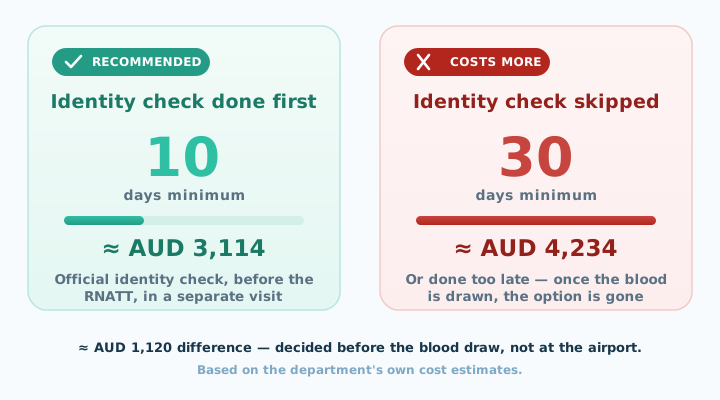
The answer
The default for a Group 3 country is a minimum 30-day quarantine. The 10-day minimum is the exception, and you qualify for it in only two ways:
- Evidence of Australian origin provided with the permit application — an Australian export certificate; or
- for animals not of Australian origin, the competent authority verified your pet’s identity before the RNAT testing.
An animal without that verification is still importable. It just serves the 30-day minimum.
What the difference costs
The department’s own estimates for importing one cat or dog:
| Quarantine | Estimated total cost |
|---|---|
| Minimum 10 days | AUD 3,114 |
| Minimum 30 days | AUD 4,234 |
Both figures are the department’s estimate of the Australian government’s share only. What the whole move costs, and when each payment falls due, is on what it costs to move a pet to Australia.
Roughly AUD 1,120, decided by whether one appointment happened before another one.
Those totals can go up: extra parasite treatments, veterinary care, an extended stay, testing where a disease of biosecurity concern is suspected, and terminal service fees charged per airway bill. Partial payment for quarantine accommodation is due when you book.
Why this is decided months in advance
The identity verification has to happen before the RNAT test, and it cannot be done in the same visit. So the order is fixed:
identity check → (separate visit) → RNATT blood sample → 180-day wait → export
By the time you are thinking about flights, the decision was made months ago. This is the single strongest argument for planning the sequence before booking anything.
What does not count as identity verification
The department is unusually direct here, because these are exactly the things people assume will work:
- A microchip scan by the government approved veterinarian during the RNATT visit. No — the identity check is a separate procedure from blood collection.
- A pet passport. Australia does not accept pet passports for importing cats and dogs at all.
- A vaccination card or microchip certificate. No.
- Anything arranged by a pet agent or shipper. The check is an official government veterinarian’s act. Agents can book the appointment; they cannot perform or supply it.
The identity check document itself is for official purposes only. It is not published online, not given to owners, and not available to pet transport agents — it goes straight from the official veterinarian to the department. If a company offers to send you “the identity check document”, that is not how it works.
What has to reach the permit application
To be assessed for the 10-day minimum, the permit application must include either the official identity declaration endorsed by the official government veterinarian, or the Australian Export Health Certificate for a pet of Australian origin — and your pet must be identifiable by the microchip listed on that document.
A mismatch between the microchip on the declaration and the microchip in your animal is not a paperwork nuisance. It is the thing the whole document exists to prove.
If the identity check is not available where you are
The department has said it is still negotiating implementation with the competent authorities of approved countries, and that official veterinarians can contact it directly with concerns. It also states the consequence plainly: without an identity check — or an Australian export health certificate — your pet is not eligible for the 10-day minimum.
If your country’s competent authority cannot yet provide one, budget for 30 days rather than hoping it resolves before your travel date.
What this page does not tell you
- What happens inside quarantine, or the daily routine at the facility.
- How to book quarantine accommodation, or current availability.
- Whether the minimum will be extended in your case — an extended stay is possible where there is a health or biosecurity concern.
- Exactly what the fee estimates include. They are the department’s estimates, reviewed annually, not a quotation.
Sources
- Cats and dogs frequently asked questions — Department of Agriculture, Fisheries and Forestrydestination_import
- Import permits for cats and dogs coming to Australia — Department of Agriculture, Fisheries and Forestrydestination_import
- Rabies vaccination and tests for cats and dogs coming to Australia — Department of Agriculture, Fisheries and Forestrydestination_import